
Infrastructure Alignment™: The Anatomy of Infrastructure Maturity
Infrastructure Intelligence Series · July 31, 2026 · By Syndia Alexandre, Founder & CEO
What changes when an organization moves out of infrastructure strain — and why the answer is alignment, not a new system or another hire.
The pattern
The first two pieces in this series examined how infrastructure strain develops. Organizations misdiagnose it, and when the underlying condition goes unaddressed, it rarely stays contained — it compounds until growth itself begins exposing the limits of the organization's financial infrastructure.
What changes when an organization moves out of infrastructure strain?
The answer isn't a new system. It isn't another hire. It isn't a better month-end checklist.
It's alignment.
Organizations experiencing infrastructure strain almost always want to fix the most visible problem first: the reporting system feels slow, a key employee is preparing to leave, leadership wants faster financial reports, ownership isn't clear. Each issue is real. Each deserves attention. But treating the most visible symptom first rarely changes the overall condition. Six months later, another symptom appears — not because the first improvement failed, but because the underlying environments never became coordinated.
The organization solved a problem.
It didn't change the system that kept producing it.
What alignment means
Infrastructure alignment isn't the process of making one function better. It's the process of bringing three operating environments into coordination.
Reporting environments transform financial activity into information leadership can confidently use, through coordinated systems, processes, and reporting cadence.
Governance environments determine how financial information is validated and acted upon, through ownership structures, review processes, accountability expectations, and decision authorities.
Operational environments carry out the day-to-day financial workflows supporting organizational execution, regardless of who happens to perform them.
Organizations rarely experience sustained infrastructure strain inside only one of these environments. Weak reporting eventually creates governance uncertainty; weak governance eventually produces operational inconsistency; and operational inconsistency eventually appears as reporting delay. The environments continually influence one another, and alignment works because it recognizes that relationship instead of treating each one as an isolated improvement project.
What changes first
Organizations rarely notice the first improvement where they expected to. Leadership expects reporting to become faster; instead, the first noticeable change is confidence. Meetings become shorter because fewer numbers require explanation. Questions receive consistent answers regardless of who responds. Teams spend less time reconstructing information and more time interpreting it. People stop relying on memory because the organization has begun relying on process. That shift is subtle, but it changes almost everything that follows.
What changes over time
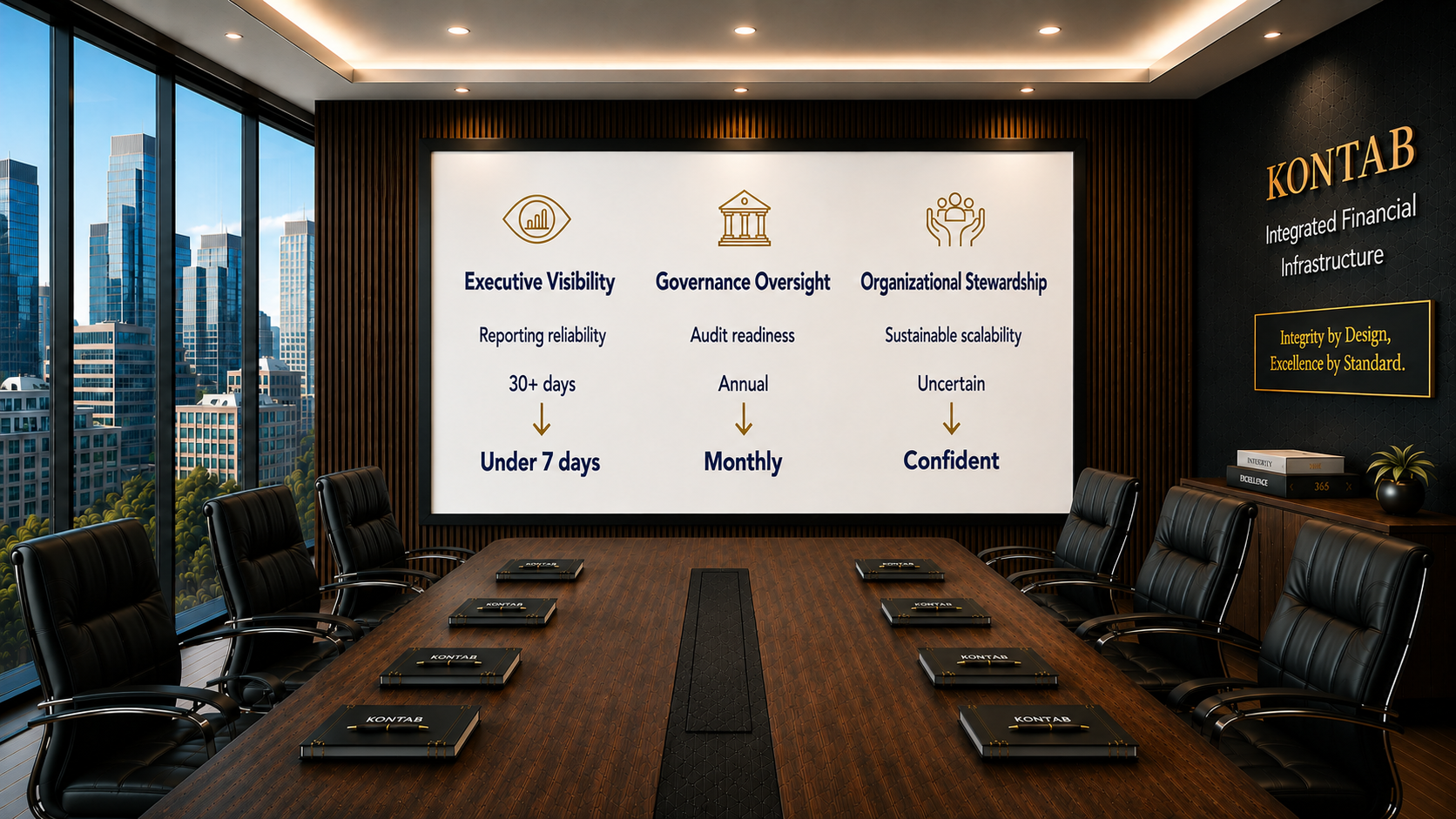
As alignment matures, the operational improvements become measurable. What was once an annual scramble to reconstruct documentation becomes a monthly discipline — the information auditors need is already current because it never had the chance to go stale. Reporting cycles stabilize because reconciliation becomes continuous rather than concentrated at month-end.
Scalability readiness changes as well. Organizations that once approached growth with uncertainty reach a point where they can confidently absorb additional grants, locations, or programs because the infrastructure underneath has already been tested against increasing complexity. Organizational readiness shifts from uncertain to approximately 90% confidence — not because growth became easier, but because the infrastructure supporting that growth became dependable.
The measurable improvements rarely surprise leadership; they simply confirm what the organization already feels.
The operating experience changes first. The numbers just make it measurable.
Why alignment is different from diagnosis
Diagnosis identifies the conditions producing infrastructure strain. Alignment changes the operating conditions that allowed those strains to develop.
One explains.
The other rebuilds.
Organizations that complete alignment aren't simply resolving today's reporting challenges — they're establishing operating conditions capable of supporting tomorrow's organizational complexity. That's why alignment has a defined endpoint: the work concludes when reporting, governance, and operational environments no longer depend on continual reconstruction to remain coordinated.
Reporting becomes dependable rather than reactive. Governance becomes structured rather than personality-driven. Operations become repeatable rather than dependent on institutional memory.
Whether reporting, governance, and operational environments require alignment rather than isolated improvements is what the Infrastructure Diagnostic™ is designed to determine before any alignment work begins.
Ready to begin? Ask Ayiti.
Get immediate answers about Kontab or where to begin: Schedule Infrastructure Diagnostic™ · Evaluate Infrastructure Awareness™ · View Integrated Financial Infrastructure™ Capability Statement
That doesn't mean the organization stops evolving — quite the opposite: growth continues, new programs launch, additional funding arrives, leadership changes, operational complexity expands. The difference is that expansion now occurs on coordinated infrastructure rather than accumulated workarounds.
Reporting, governance, and operations were never three separate problems — they were always one infrastructure that hadn't yet been coordinated.
Alignment establishes the operating conditions.
Stewardship preserves them.
Ready to begin? Ask Ayiti.
Get immediate answers about Kontab or where to begin: Schedule Infrastructure Diagnostic™ · Evaluate Infrastructure Awareness™ · View Integrated Financial Infrastructure™ Capability Statement