
Infrastructure Maturity: The Foundation for Effective Stewardship
Infrastructure Intelligence Series · October 31, 2026 · By Syndia Alexandre, Founder & CEO
Why infrastructure maturity isn't a milestone organizations reach once — and why sustaining it depends on cadence, not another one-time fix.
The pattern
The first three pieces in this series followed the same organizational story from different perspectives: organizations misdiagnose infrastructure strain; left unaddressed, that strain compounds; and infrastructure alignment restores coordination across reporting, governance, and operational environments.
If the organization is now aligned, isn't the work finished? In practice, that's rarely what happens.
Organizations almost never lose infrastructure maturity all at once. They drift away from it. A new program launches, a department restructures, a long-tenured employee retires, a funding source introduces new reporting requirements, a board committee requests additional financial information. None of these changes create infrastructure strain on their own — they simply introduce small adjustments into operating environments that were previously coordinated.
One adjustment becomes many: a temporary workaround becomes permanent, a monthly review becomes quarterly, documentation falls one cycle behind, ownership gradually shifts without anyone formally deciding that it should.
Nothing appears obviously wrong.
Until someone notices the organization is beginning to solve familiar problems again.
What stewardship preserves
Infrastructure stewardship doesn't exist to rebuild alignment — it exists to preserve it. This is what Infrastructure Oversight™ is built to do: keep coordinated operating conditions intact as the organization continues changing around it.
The work is less about solving visible problems than recognizing subtle changes before they become structural ones. One reconciliation takes longer than usual. A reporting package requires more manual adjustments than it did three months ago. Questions begin returning to the same individuals instead of the documented process. None of those observations are significant by themselves, but together they represent the earliest signals that infrastructure is beginning to drift.
Organizations rarely lose infrastructure maturity because of one major event.
They lose it through dozens of small adjustments that no longer appear connected.
Why cadence matters
One difference consistently separates organizations that preserve infrastructure maturity from those that gradually return to infrastructure strain: they review infrastructure on purpose — not because something feels wrong, but because waiting until something feels wrong means the drift has already become visible.
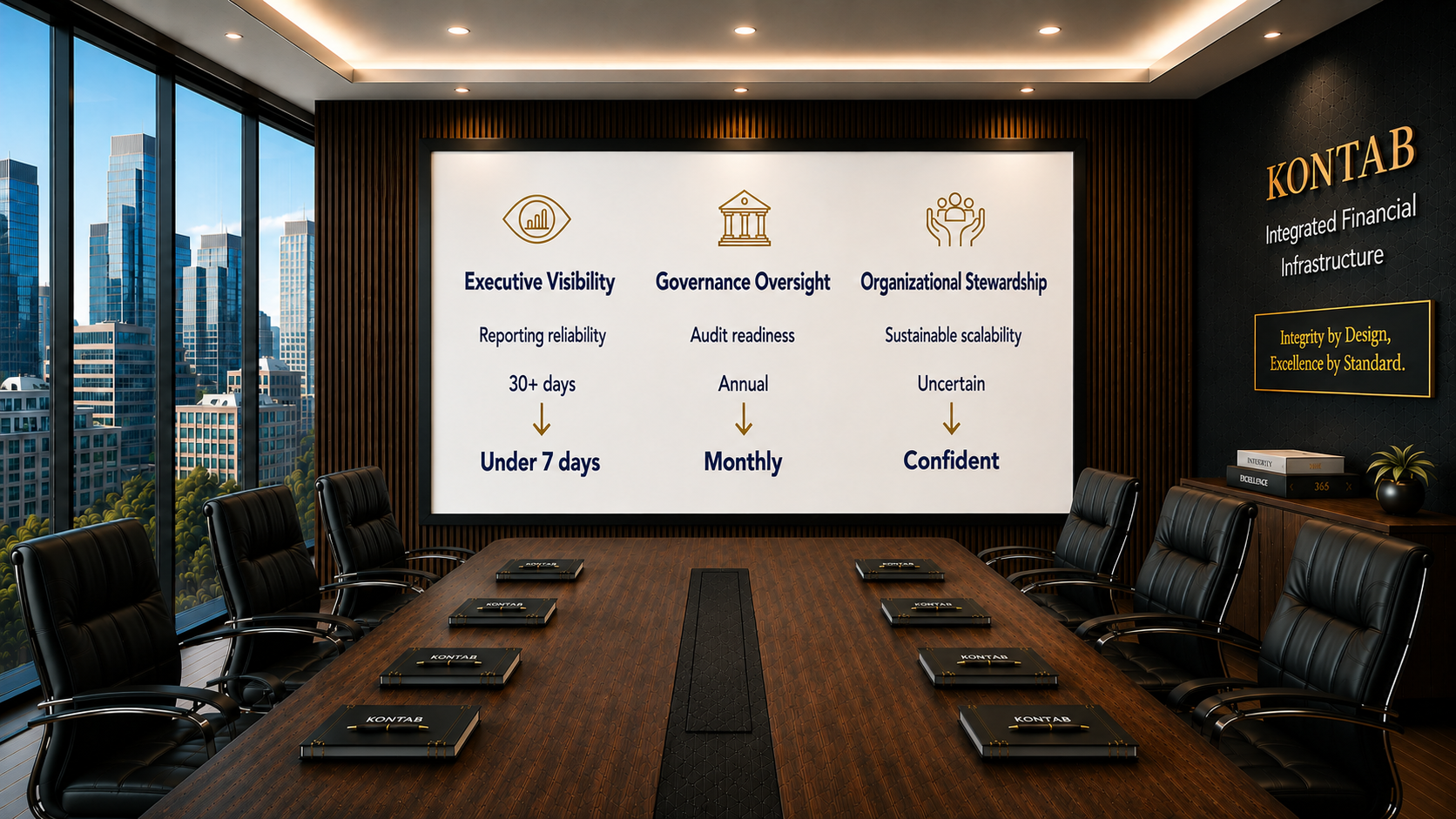
This is why stewardship depends on cadence rather than reaction. Monthly governance reviews replace annual reconstruction. Operating conditions are reviewed before questions become concerns, and infrastructure is evaluated while changes are still small enough to correct without disrupting the organization.
The cadence itself is the mechanism. Without it, organizations eventually return to the same pattern described earlier in this series — not because the original alignment failed, but because the organization continued evolving while its infrastructure remained still.
Recognizing whether an organization is stewarding well or drifting is exactly what Infrastructure Oversight™ is built to monitor — beginning, as every engagement does, with the Infrastructure Diagnostic™.
Ready to begin? Ask Ayiti.
Get immediate answers about Kontab or where to begin: Schedule Infrastructure Diagnostic™ · Evaluate Infrastructure Awareness™ · View Integrated Financial Infrastructure™ Capability Statement
What changes over time
Organizations practicing stewardship describe the changes differently than organizations completing alignment: the improvements are less dramatic, but steadier. Reporting remains dependable rather than alternating between periods of stability and reconstruction. Audit readiness remains a monthly discipline instead of gradually returning to an annual exercise. Leadership continues making decisions with current information rather than discovering months later that reporting reliability has quietly deteriorated.
The most significant shift is organizational confidence. Growth stops feeling like something that threatens operational stability and becomes something the organization expects its infrastructure to absorb. A milestone doesn't prove infrastructure maturity; sustaining coordinated operating conditions while complexity keeps increasing does.
Why stewardship is a distinct discipline
Diagnosis explains.
Alignment rebuilds.
Stewardship preserves.
Each answers a different organizational question. Diagnosis asks what is producing infrastructure strain. Alignment asks what must change to restore coordinated operating conditions. Stewardship asks what must continue happening so coordination doesn't quietly disappear.
Those questions cannot be answered by the same engagement because they exist at different stages of organizational maturity: alignment has a completion condition; stewardship does not.
Organizations stop aligning.
Healthy organizations never stop stewarding.
Ready to begin? Ask Ayiti.
Get immediate answers about Kontab or where to begin: Schedule Infrastructure Diagnostic™ · Evaluate Infrastructure Awareness™ · View Integrated Financial Infrastructure™ Capability Statement
This concludes the four-part Infrastructure Intelligence series on infrastructure maturity for organizations navigating complexity across reporting, governance, and operations.
← Back: Infrastructure Alignment™: The Anatomy of Infrastructure Maturity