

○
GAAP Compliant
○
2 CFR 200 Mastered
○
Clean Audits
○
Structured Reporting
○
Growth & Sustainability Alignment
○ GAAP Compliant ○ 2 CFR 200 Mastered ○ Clean Audits ○ Structured Reporting ○ Growth & Sustainability Alignment
Case Studies & Strategic Perspectives
How Kontab designs and operates financial infrastructure for organizations managing complex, multi-source funding—and the insights that inform our approach.
Real systems. Measurable outcomes. Executive-level impact.
Each engagement reflects Kontab’s role as a structured financial infrastructure partner.
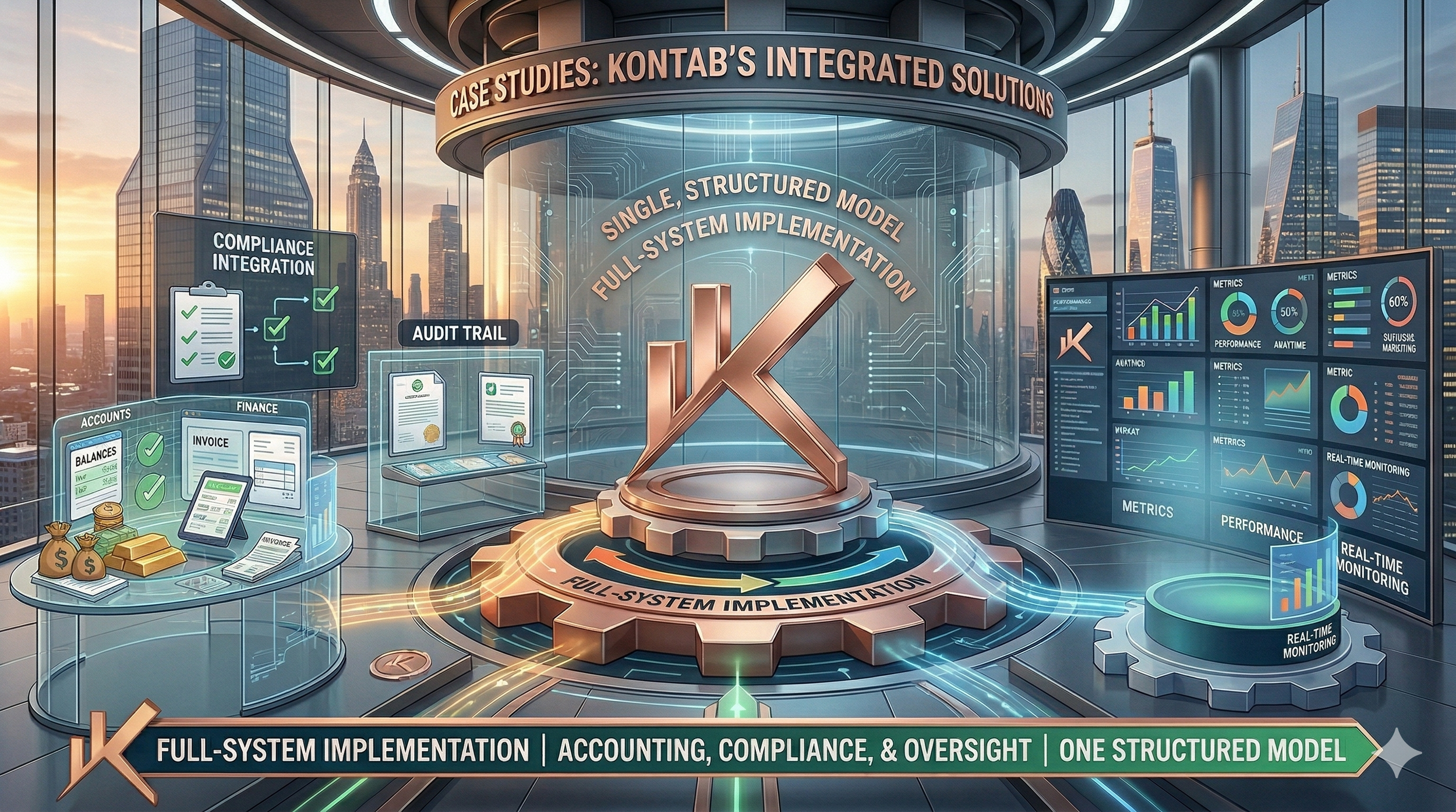
Financial Infrastructure Transformations
System-level implementations establishing compliance, visibility, and scalable financial operations.
-
Multi-program organization
Managing 5+ funding streams
$3M–$10M+ in funding
-
Fragmented reporting across funding sources
30+ day reporting cycles
Inconsistent allocation methodologies
Elevated audit and compliance exposure
-
Kontab implemented a unified financial infrastructure:
Designed fund-level accounting structure
Integrated reporting across all funding streams
Standardized allocation methodology
Established audit-defense controls and documentation
-
Reporting cycle reduced from 30+ days to under 7 days
Full visibility established across 5+ funding streams
Audit-ready financial structure implemented
-
Leadership operates with consistent, system-level visibility across all funding streams.
Decision-making is supported by reliable, timely financial data aligned with operational and strategic priorities.
Compliance and reporting risks are structurally mitigated through integrated controls and standardized financial processes.
Financial System Transformation — Multi-Source Funding Organization
-
Federally funded organization
Subject to Uniform Guidance requirements
-
Recurring audit findings
Weak internal control structure
Reactive compliance processes
-
Kontab implemented a structured compliance and reporting framework:
Established Uniform Guidance-aligned controls
Rebuilt financial reporting systems
Standardized documentation practices
Integrated ongoing compliance oversight
-
Prior audit findings resolved
Fully auditable financial systems established
Audit preparation timelines reduced
-
Leadership operates with confidence in audit outcomes and overall compliance posture.
Regulatory exposure is materially reduced through system-level controls and continuous oversight.
Financial operations are managed proactively, with compliance embedded in system design.
Audit & Compliance Stabilization — Federally Funded Organization
-
Scaling organization
Increasing funding complexity
-
Financial systems not designed for scale
Limited visibility into performance
Increasing operational strain
-
Kontab implemented scalable financial infrastructure:
Restructured fund accounting system
Implemented leadership-aligned reporting framework
Integrated multiple funding streams into a unified system
Established continuous financial oversight
-
Financial systems aligned with growth trajectory
Visibility into financial performance established
Operations were standardized, reducing inefficiencies and improving execution
-
Leadership operates with the financial clarity required to support strategic growth and resource allocation.
Operational complexity is managed through structured systems rather than reactive processes.
The organization scales without requiring reconstruction of its financial infrastructure.
Infrastructure for Scale — Growing Organization
Financial Leadership in Complex Situations
Supporting organizations through critical financial decisions, transitions, and structural challenges.
-
Multi-program organization
Experiencing reduced funding levels
-
Cost structure misaligned with funding levels
Financial uncertainty
Risk of operational disruption
-
Realigned cost allocations across programs
Established scenario-based financial reporting
Identified inefficiencies and structural gaps
Stabilized financial controls
-
Cost structure aligned with funding levels
Financial visibility established during transition
Operational stability maintained
-
Leadership makes restructuring decisions with clear visibility into financial constraints and trade-offs.
Operations remain stable during financial contraction, supported by structured financial systems.
Right-Sizing Financial Infrastructure — Funding Contraction
-
Board-governed organization
Managing restricted endowment
-
Lack of structured financial narrative for board approval
Limited visibility into long-term impact
Misalignment between leadership and governance
-
Built forward-looking financial models
Aligned reporting with board-level decision criteria
Structured financial narrative supported by data
Integrated financial data into a cohesive decision framework
-
Board presented with a clear, structured financial case
Alignment established between leadership and governance
Decision supported by data-driven analysis
-
Leadership presents defensible, data-driven financial positions aligned with governance expectations.
Board-level decisions are made with clarity, supported by structured financial analysis.
Executive Financial Narrative — Endowment Withdrawal Approval
-
Organization managing multiple funding streams
-
Lack of defined financial performance indicators
Inconsistent reporting across programs
Limited operational visibility
-
Defined key financial indices aligned with organizational objectives
Built standardized reporting frameworks
Integrated data across funding streams
Aligned reporting with leadership decision-making
-
Financial performance visibility established
Reporting standardized across programs
Operational insight improved
-
Leadership monitors performance through structured financial indicators rather than fragmented reporting.
Strategic decisions are supported by consistent, organization-wide financial visibility.
Performance Visibility — Key Financial Index Tracking
-
Organization managing restricted funds
-
Uncertainty in true fund balances
Inconsistent tracking and reporting
Audit and compliance exposure
-
Reconciled restricted fund balances
Validated allocation and usage
Standardized tracking and reporting systems
Aligned financial records with compliance requirements
-
Accurate validation of restricted fund balances
Audit readiness established
Reporting consistency achieved
-
Leadership operates with clarity on true financial position across restricted funds.
Audit and compliance exposure are materially reduced through validated reporting and structured financial controls.
Restricted Funds Validation — True Net Position
Observed Outcomes Across Organizations
In organizations where financial infrastructure is not properly designed—or not followed—patterns emerge that impact stability, compliance, and long-term sustainability.
-
Negative net equity
Pricing below cost structure
Misalignment between revenue and cost
-
Restructured pricing models
Aligned cost of goods with revenue
Implemented margin-based financial structure
-
Net equity restored to a positive position
Financial stability re-established
Sustainable revenue structure implemented
-
Financial sustainability requires alignment between pricing, cost structure, and financial infrastructure—not revenue growth alone.
Restoring Financial Stability — Pricing & Cost Misalignment
-
Financial decisions made without alignment to structured financial systems.
-
Unsustainable compensation increases
Misinterpretation of restricted funding
Cash constraints
-
Workforce reductions
Operational disruption
Financial instability
-
Financial decisions made outside structured infrastructure introduce risks that are not immediately visible—but become operationally significant over time.
Operational Disruption — Decisions Outside Financial Infrastructure
-
Inconsistent or incomplete financial reporting structures.
-
Significant funds returned due to reporting inaccuracies
Unrecognized revenue
Cash flow constraints
-
Incorrect reporting
Unreliable budgeting
Audit risk
-
Financial reporting is the foundation of financial visibility, compliance, and decision-making—not a downstream activity.
Financial Exposure — Reporting Misalignment
What We See Across Organizations
Across engagements—and in organizations operating without structured financial infrastructure—consistent patterns emerge that directly impact financial stability, compliance, and long-term viability.
Financial Visibility Is Often Delayed or Misaligned
Implication: Leadership decisions are made without real-time clarity.
Compliance Risk Is Embedded in System Design
Implication: Audit and reporting risks are systemic—not isolated.
Financial Decisions Occur Outside Structured Constraints
Implication: Short-term decisions create long-term instability.
Growth Without Infrastructure Leads to Instability
Implication: Increased funding introduces complexity without control.
Reporting Inaccuracies Create Financial Exposure
Implication: Organizations lose access to capital and financial clarity.
Reactive Systems Require Rebuilding
Implication: Organizations face disruption during critical periods.
Executive Conclusion
Financial challenges do not originate from isolated accounting issues.
They originate from systems not designed to support complexity, compliance, and growth.
Strategic Position
Organizations that invest in structured financial infrastructure operate with clarity, control, and confidence.
Those that do not operate with increasing complexity and risk.
From Fragmentation to Structure
Organizations do not struggle because of a lack of accounting support.
They struggle because their financial systems were not designed for complexity.
Kontab addresses this at the system level—designing infrastructure that supports compliance, visibility, and growth.

Featured Strategic Perspectives
Assess Financial System
A structured evaluation of your financial infrastructure, compliance posture, and reporting systems.
The 2-minute entry point to The Kontab Financial Infrastructure Framework™ Phase 1 Diagnostic.
A structured approach to designing integrated financial systems.